
No. 01 — Significant health care reform will return to the election debate in 2028
One poll can’t predict the future, but when you place the results in context, they can sometimes give you strong clues. Such is the case with the poll Healthier United just fielded in Michigan, which laid out breadcrumbs on what to expect within the health care debate in the 2028 election. Here’s where they led me …
When President Obama won re-election in 2012 after passing the Affordable Care Act, approval for the ACA itself was only at 42% among registered voters. When Sen. John McCain saved Obamacare in 2017 with his famous “thumbs down” vote in the Senate, that figure stood at about 51%. In April of 2024, despite also making remarks about replacing the ACA, President Trump said, “I’m not running to terminate the ACA.” Uncoincidentally, the ACA’s approval then stood at 60%. Today, approval is nearly as high as it’s ever been, at 61%, but health care as a political issue is far from settled.
We are now entering a new phase of the health care debate. Significant reform proposals will be back on the table. Despite approving of the ACA, voters are now consistently reporting health care costs as a top concern, including in our Michigan polling, and more of them say they’re ready to go even further by embracing Medicare for All.
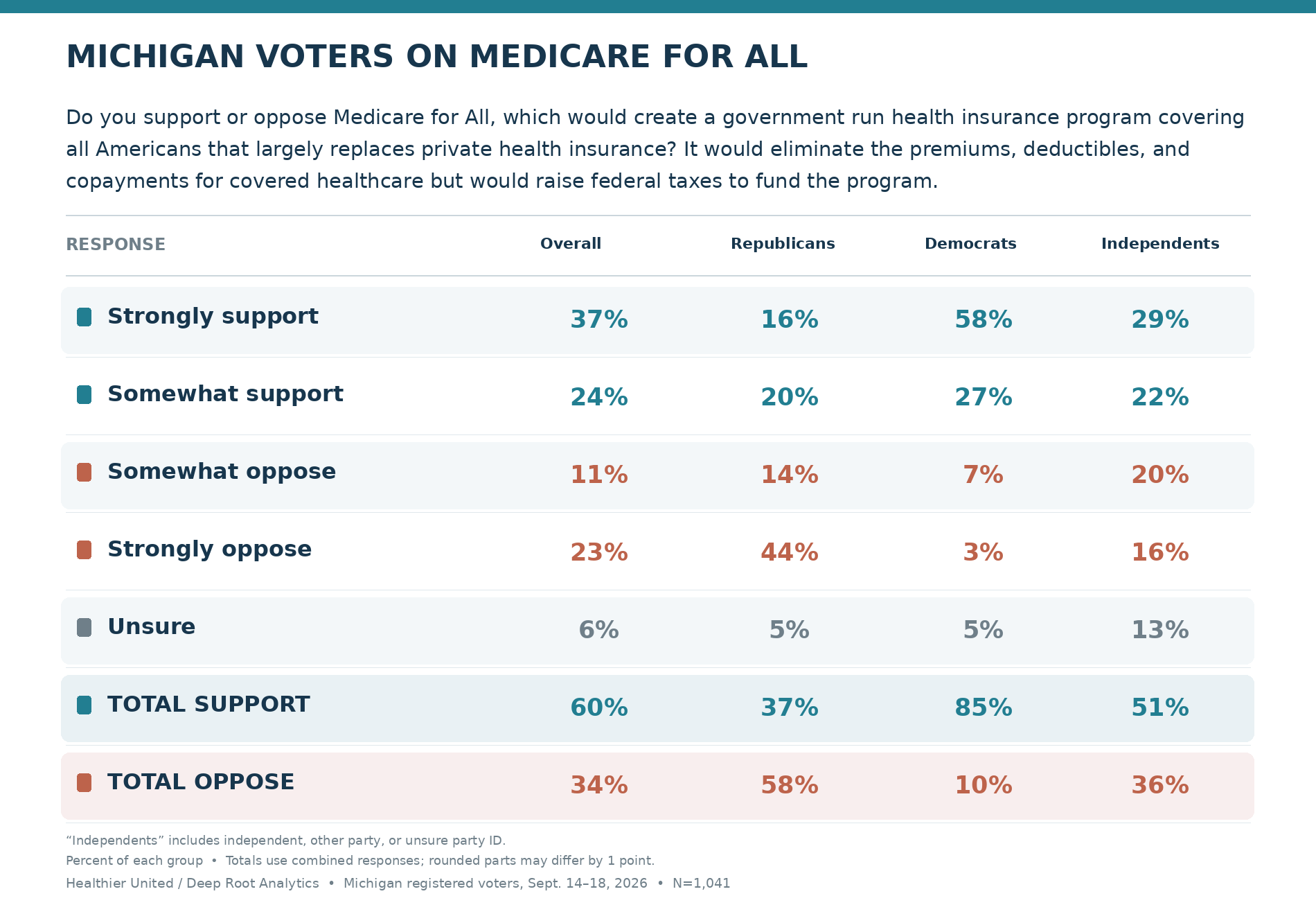
Michigan voters on Medicare for All: 60% support, 34% oppose, 6% unsure.
Support by party: 37% of Republicans, 85% of Democrats, 51% of Independents.
Oppose by party: 58% of Republicans, 10% of Democrats, 36% of Independents.
Source: Healthier United / Deep Root Analytics. 1,041 Michigan registered voters, Sept. 14–18, 2026.
“Medicare for All” was +15 among Independent voters, and, with 60% support overall, it outperformed its most notable proponent on Michigan’s statewide ballot this year, Abdul El-Sayed, whose total favorability was 46%. This support appears to represent an upward shift of nearly 20 points from six years ago. A January 2020 poll of Michigan general election voters, which did not invoke the specter of raising taxes as ours did, found the proposal underwater with 41% support and 51% opposition overall.
As we head toward 2028, a ripe environment for reform sentiment will likely persist. January 1, 2027, is a key implementation date for H.R. 1’s Medicaid work requirement and redetermination provisions, which will result in Medicaid coverage loss and cost shift that will negatively impact the broader health care market. As these policy and market dynamics play out, the politics of the 2028 presidential race will ramp up.
Eighty-five percent of Democrats in our poll supported Medicare for All, and a sample of primary-voting Democrats would likely show more intense support. The 2028 cycle will be the first competitive Democratic primary for president in 8 years. There will almost assuredly be one or more Democrats running for president who take up the Medicare for All mantle, and, in turn, those who do not will have to explain why. Whereas the “public option” was the elusive stretch goal of the Obama administration during the ACA legislative campaign, I believe it will be the table stakes for any viable Democrat running for president in 2028.
On the Republican side, holding on to what’s become a key part of their coalition in working-class voters will likely require a position of status quo disruption that presents as meaningfully addressing health care costs. In 2012, Romney was -22 and -10 with voters in households making under $50k and $100k, respectively. In 2024, Trump was +2 and +4. However, in our Michigan poll, only 37% of that group under $100k approved of Trump’s job performance.
While the policy in H.R. 1 doesn’t match up with a strategy to hold this demographic, the recent rhetoric is more aligned. President Trump recently proposed bypassing payments to “big, fat, rich insurance companies.” In Michigan’s U.S. Senate race, Republican Mike Rogers has proposed new transparency regulations for insurance carriers and hospitals, which garnered the support of about 9 in 10 voters in our poll. This is likely to be the type of positioning we will see among Republican candidates in 2028, which is adapted for a world in which 70% of Republican voters say they’re more likely to vote for a candidate “who wants to break up big health insurance companies,” and one in which 36% of voters in our Michigan poll who reported voting for President Trump in 2024 also expressed support for Medicare for All.
On a schedule determined by the availability of time and possible possession of something useful to say, Jake Williams, CEO of Healthier United, sends “field notes” to a small group of colleagues that transmit observations on health politics and policy.